
Grant County Arrest Records and Charges
Grant County arrest records start with law enforcement activity, booking, custody, or citation. The Sheriff's Office and jail are the local custody-side sources, while OSP criminal history records may show statewide arrest or conviction history products. No official Grant County online jail roster was found in the research, so current custody questions route to the jail by phone rather than a county web roster.
Court charges after arrest start when the prosecutor files or pursues the formal accusation. The Grant County District Attorney prepares and files formal charges, conducts hearings and trials, and advises law enforcement during investigations and evidence gathering. Once charges are filed in court, they become part of the court charge record and later the full criminal court record. Custody and jail information belongs with Grant County inmate records; final case outcomes belong with Grant County criminal court records.
The Grant County District Attorney page identifies the local prosecution office that prepares and files formal criminal charges.
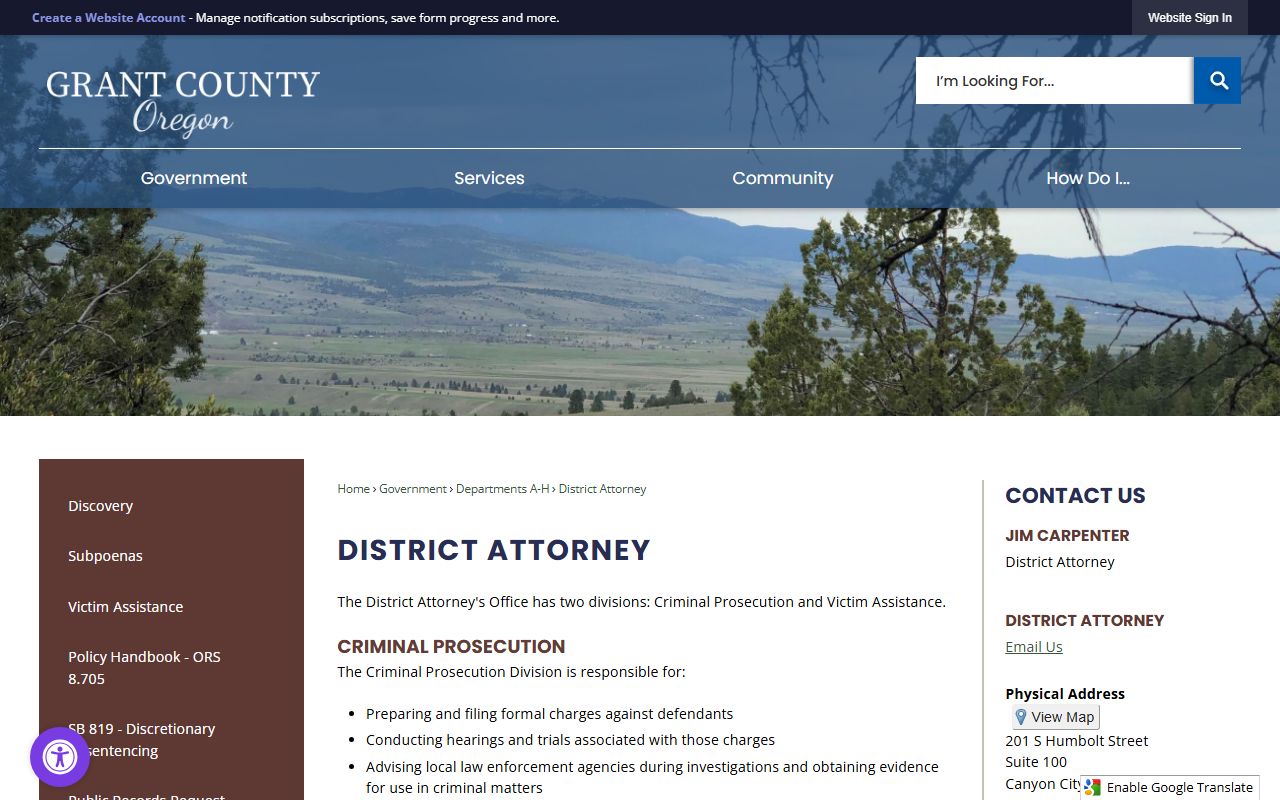
That prosecutor role is why the arrest record and the court charge record should be read as related but separate records.
Find Grant County Arrest Records and Charges
There is no single Grant County arrest records portal that combines jail booking, prosecutor charges, and court disposition. The official path is a set of custodians. For the charge record, search the OJD public case portal by defendant name, case number, citation number, or record number. For custody status, contact Grant County Jail. For sheriff records, contact the Sheriff's Office. For prosecution discovery or DA public records, use the District Attorney's request channels.
- Search the OJD portal for the court case by defendant name, citation number, case number, or record number.
- Open the case and review charge entries, events, warrants, disposition, and financial sections where public.
- Contact the Circuit Court records office for certified copies or documents not shown in free search.
- Contact the jail or Sheriff's Office for custody and arrest-side records that are not part of the court file.
- Use DA discovery or DA public records forms only for records held by the prosecutor.
Statewide history checks through Oregon State Police are a separate route. OSP records may be useful for broader criminal history, but they do not replace the charge-by-charge court record in Grant County.
Charges After Arrest Documents
The charge record begins when an accusation is filed with the court. The research identifies complaints, informations, indictments, citations, and case events as ways a charge can appear. The exact document depends on the type of offense, the charging route, and court practice. One arrest can lead to no filed case, one charge, or several separate counts.
| Document Type | Who Uses It | What It Does |
|---|---|---|
| Complaint | Prosecutor or authorized charging process | States the accusation and can start or support a criminal case. |
| Information | Prosecutor | Formal prosecutor-filed charge document used for many criminal cases. |
| Indictment | Grand jury process | Formal charge returned through grand jury review, often for serious felony matters. |
| Citation | Law enforcement or court process | Written charge or summons that may route a violation, traffic, or criminal matter to court. |
Grant County Charge Status
Charge status is the key to reading court charges after arrest. A charge may be pending at arraignment, amended during negotiations, reduced as part of a plea, dismissed by court order or prosecutor action, or resolved by conviction after a plea or trial. The docket and disposition fields must be read together because a charge list alone can be misleading.
| Status | What It Means |
|---|---|
| Pending | The accusation is still active and has not reached final disposition. |
| Amended | The original charge language, count, or statute reference changed during the case. |
| Reduced | The case moved to a lower or different offense as part of court action or negotiated resolution. |
| Dismissed | The charge ended without conviction on that count. |
| Convicted | The charge resulted in guilt by plea, no contest where accepted, or trial verdict. |
Grant County DA Discovery Requests
DA discovery is not a general public charge search. It is a criminal case process for defendants and attorneys. The Grant County DA discovery page says represented defendants or those planning to hire counsel must have the attorney request reports. Discovery must be requested in writing, is available the day before arraignment, must be requested at least 24 hours in advance, and must be paid for at pickup.
The DA discovery page publishes local discovery rules and fees for criminal charge records and prosecution materials.
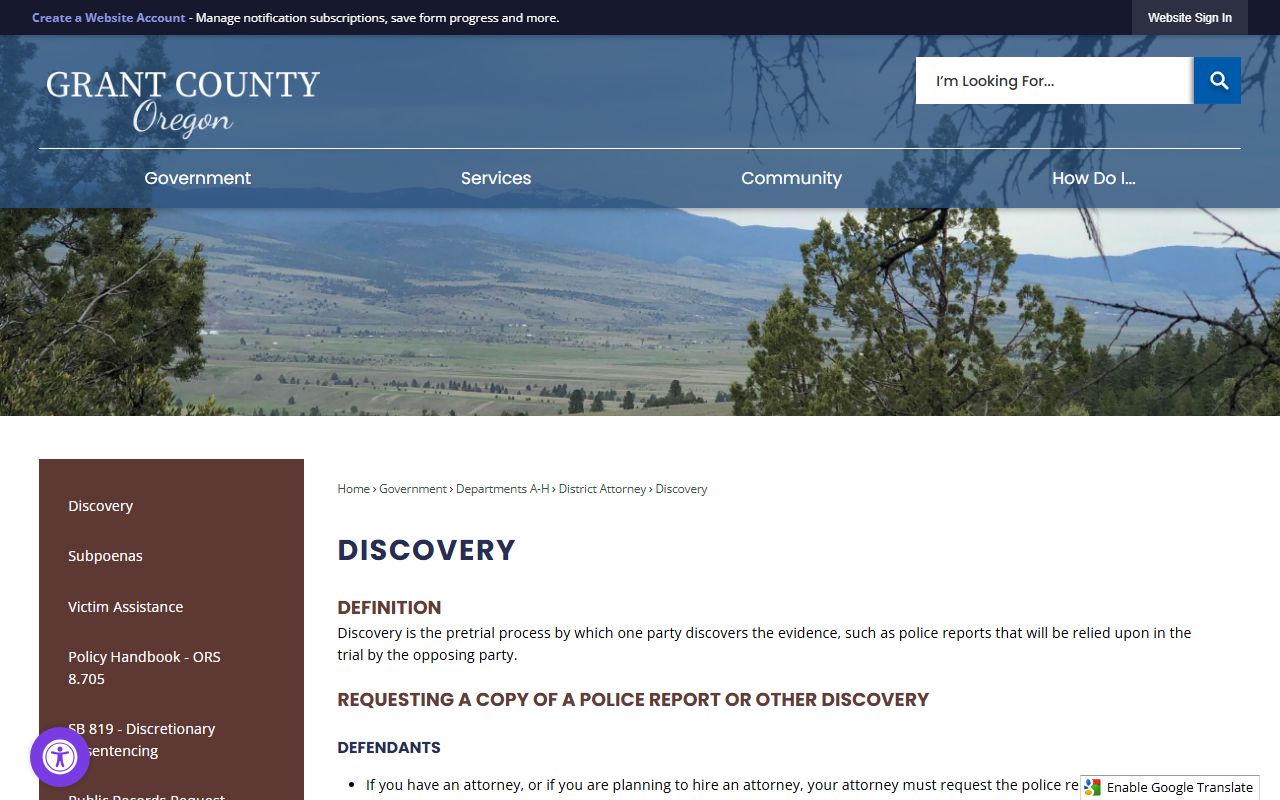
Discovery is most relevant after charges have been filed and a defendant or attorney needs the reports and media behind the prosecution case.
| Discovery Category | Researched Rule or Fee |
|---|---|
| Written request | Required; attorney requests need a Letter of Representation. |
| Pickup | Only the defendant may request and pick up discovery unless counsel handles the request. |
| Misdemeanor | $50 |
| Felony non-Measure 11 | $100 |
| Felony Measure 11 | $250 |
| Probation violation | $20 |
DA Public Records Requests
The DA public records route is separate from discovery. The research identifies a DA Public Records Request Form with requester name, contact information, case number if known, reason for request, requested information, signature, and District Attorney response fields. The DA fee schedule requires an estimate and prepayment before work begins, includes labor charges after the first quarter-hour, and states that the office practice is not to waive fees.
The Grant County DA public records request page is the official public-records route for prosecutor-held charge and case materials.
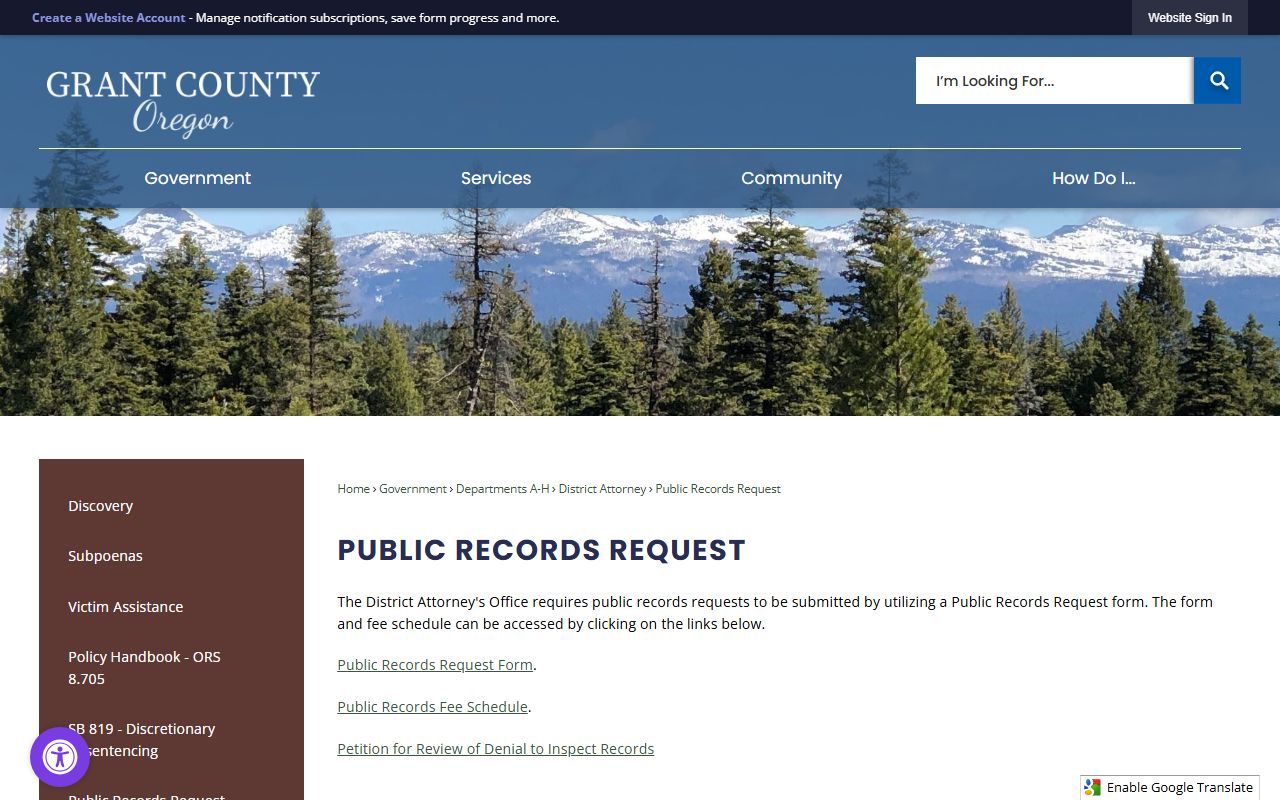
This channel should be used for DA-held records, not for court-certified copies, jail custody checks, or OJD case-register searches.
Note: Pending case records may be restricted, and dispatch records are limited to dispatch material, not law enforcement case files.
Charges vs Convictions
Grant County arrest records and court charges can show an arrest or accusation even when no conviction follows. A charge is what the prosecutor or citation process brings into court. A conviction is a court outcome. Public users should read the later docket entries, judgment, and sentence before treating a charge as the final result.
| Point | Charge | Conviction |
|---|---|---|
| Meaning | An accusation filed or pursued in court. | A finding or plea that establishes guilt on a count. |
| Timing | Appears early in the court case after arrest, citation, or referral. | Appears after plea, verdict, or accepted resolution. |
| Can change | May be amended, reduced, or dismissed. | May lead to sentence, fines, probation, or restitution. |
| Where to verify | OJD case events, charging document, DA discovery where eligible. | Disposition, judgment, sentence, and financial entries in the court record. |
Sealed vs Expunged Charges
Oregon's set-aside process can apply to eligible convictions, arrests, citations, charges, guilty-except-for-insanity judgments, and certain contempt findings under ORS 137.225. After a court grants a set-aside, the record is sealed from ordinary official court-record display. Eligibility depends on the offense, waiting period, criminal history, and completion of sentence requirements.
| Point | Sealed Record | Expunged / Set Aside Record |
|---|---|---|
| Public display | Closed from ordinary public inspection. | Not shown in ordinary official court record display after the order. |
| How it happens | By law, policy, or court order. | By motion and court order under Oregon set-aside law. |
| Applies to charges | Can apply when a charge or case category is restricted. | Can apply to eligible arrests, charges, citations, and convictions. |
| Limits | Authorized access may still exist. | Federal checks or rare unsealing may still matter. |
Restricted Arrest and Charge Records
Not every arrest-linked or charge record is public. Juvenile records are confidential, and the Grant juvenile records page says non-parties must file a motion and proposed order to seek access. Adoption, mental health, VAWA-related matters, sealed cases, and set-aside records may be withheld from public court search. The public OJD portal also excludes addresses, Social Security numbers, and other personal identifiers.
Arrest-side records can have their own limits. Dispatch records are limited to dispatch records, pending case records may require DA approval before release, and law enforcement case files must be requested from the correct agency. For a charge that is already in court, the OJD case search and Circuit Court records office are the better path to the formal court record.
Grant County Charge Record Offices
Use the office that holds the record. The District Attorney handles discovery and DA public records. Circuit Court handles the criminal court record once a case is filed. The Sheriff's Office and jail handle arrest, custody, and sheriff records. Justice Court handles non-felony and citation matters filed there.
Grant County District Attorney
201 S Humbolt Street, Suite 100
Canyon City, OR 97820
541-575-0146
Monday-Thursday, 7:30 a.m.-noon and 12:30 p.m.-5 p.m.; Friday, 8 a.m.-noon
Grant County Jail
205 S Humbolt
Canyon City, OR 97820
541-575-1134
Call for custody status because no official online jail roster was found.